

What content designers need to know about GOV.UK Chat

By Angela Moore
Angela is a content designer, strategist and and long-term Scrollie. Over the last decade, she’s worked on all sorts of government services and designed content for GOV.UK about everything from Universal Credit to farm subsidies, legal aid and school performance data.
What actually is GOV.UK Chat?
GOV.UK Chat was officially launched on 14 May. It’s been billed as ‘the biggest change to how people interact with government content since the GOV.UK site was launched in 2012’. So, what actually is GOV.UK Chat, and does it merit all this fanfare?
GOV.UK Chat is an AI-powered conversational assistant. (It’s currently only available through the GOV.UK app.) Users ask questions in plain English and get tailored answers drawn from a range of different pages on the site.
This means that users don’t need to browse, search or otherwise try to navigate the site - Chat does the hard work for them.
What is the user need?
We know that AI is already rapidly changing user behaviour. People are increasingly using LLMs to interact with government. This is particularly true in the early part of user journeys - the ‘find out about’ part.
And we know that for many users, this is absolute jam. It feels like answers at your fingertips, in conversational language that makes sense. It saves people from doing the confusing, laborious work of navigating the endless maze of online guidance, on and off GOV.UK.
We have a responsibility to help people get accurate, accessible government information. It would be madness not to experiment with building something to meet their needs in a safer, better way than LLMs in the wild.
How GOV.UK Chat works
Chat uses ‘retrieval-augmented generation’. This means that it does not rely solely on what an AI model already knows, or on searching the GOV.UK website.
Instead, it searches a curated collection of official GOV.UK content. It finds the most relevant sections for a user's question and turns that information into clear, conversational answers.
This 'curated collection' is a version of GOV.UK content that has been specifically prepared for the tool to search. ‘Normal’ GOV.UK content is organised and broken down into smaller, meaningful chunks. The system:
uses metadata to filter and rank content
applies hierarchical semantic chunking based on the HTML structure
retrieves the most relevant sections rather than entire pages
This makes it easier to find the specific guidance needed to answer a user's question- even when the information is spread across multiple pages.
There’s a good blog post about the data science and engineering behind the tool (opens new tab).
Chat only uses content in guidance formats
We’ve said that Chat searches a curated collection of official GOV.UK content. This collection currently only includes content in guidance formats. (This means both mainstream and Whitehall guidance.)
This is because Chat needs maintained, actionable content in order to give up-to-date and accurate answers.
Guidance is (in theory - more on this later…) maintained, in that it’s updated to keep it current and archived if necessary. It’s actionable, in that it tells a user what to do right now.
Content types such as press releases, speeches or policy papers are excluded because this information might be time-specific, or otherwise not reflective of what action a user can take.
This means Chat currently works off around 80,000 pages of GOV.UK content.
It cannot base answers on PDFs or graphics
GOV.UK Chat currently works with text. It cannot use information contained only in PDFs or graphics in the same way it can use structured HTML content.
(If your department is among those still insisting on publishing guidance in PDF, please join the chorus of content designers everywhere - “We told you so!”)
Is it safe for people to use?
We all know about the problems with conversational AI - hallucinations, wild overconfidence even when wrong, etc. And people make really important decisions based on government content.
The team designing the tool has done great work to mitigate this, given the constraints. Grounding the system on GOV.UK content covers some of that. Other safeguards include:
including a link back to the source guidance for every answer, so a user can check
asking clarifying questions when the tool is not sure what a user means, rather than just assuming
not answering a question when there is not enough reliable information to do so, and acknowledging uncertainty
detecting and discouraging personal information from users
There are a bunch of technical background safeguards, too, and there was a a lot of evaluation and testing (including by humans) in the design and development.
This is not to say that the system is 100% safe and accurate; I personally absolutely cannot be bothered to check every cited link when I use it. But the team has overall been cautious, thoughtful and safety-minded.
This is even more reason to do good content work
The GOV.UK Chat team have some very straightforward advice. If you want to get the most out of the tool, you need to sort out your content estate.
Poor content will directly affect the quality of answers. (Yes! Like so many other ‘fix-it-with-AI’ projects we hear about, this one also relies directly on good content design.)
This is a new technology, but most of the things it needs from content are not new at all. Clear headings, consistent and user-focused language, well-structured accessible guidance, no duplication, good metadata and HTML - all of these help both humans and machines.
This is true of AI more widely, too. Dodgy, outdated content might previously have hidden in the zero-view silt at the bottom of the GOV.UK ocean. Now, LLMs might pitilessly find that and expose it to users, confidently, as the answer to their question.
We would hope that this is a further argument for departments to fund proper GOV.UK work, particularly on Whitehall content.
We hope that GOV.UK Chat will share the data
The way people use Chat could help identify unmet user needs and gappy, unclear or inaccurate guidance. There are potentially some very good feedback loops here.
Conversational systems expose user intent differently from traditional analytics. Users stop entering fragmented search terms and start describing actual situations. For example, not:
‘child benefit threshold’
But:
‘I moved in with my partner halfway through the year and now I'm confused about whether we still qualify.’
That's potentially much richer insight into where guidance is failing people. We hope that GOV.UK Chat will be actively and openly sharing this data with content teams.
So, is it worth the fanfare?
It surely represents a meaningful change. For more than a decade, we’ve asked people to come to a website and find their way through an increasingly huge and disjointed body of information.
The Chat proposition is more: ‘Tell us what you need. We'll try to find the relevant information and explain it to you.’ The team has also recognised the potential to do more - offer simple transactions, hand users over to departmental customer support or services.
Thinking about all of this, I was reminded of this by Richard Pope, from a very, very early sketch of GOV.UK (opens new tab):
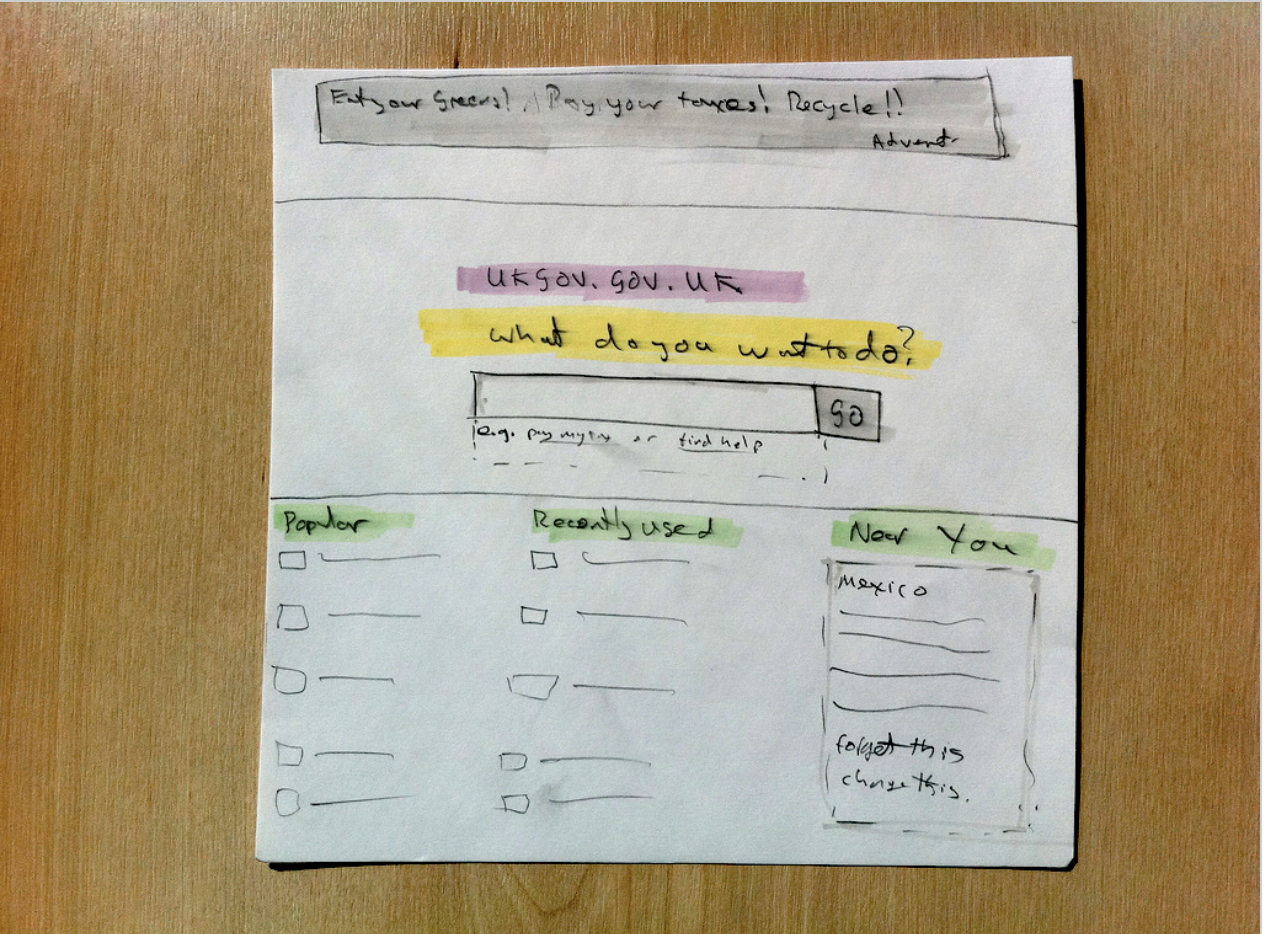
Look at the big call to action: “What do you want to do?” GOV.UK Chat may be a small step towards that early vision.
Regardless, as content designers, we’re missing a trick if we do not lean into this, learn from it, and learn from the teams already working on sorting out their content estates for this and other AI.
Need an expert team of content designers and strategists to sort out your GOV.UK content estate? Scroll can help. Get in touch.